
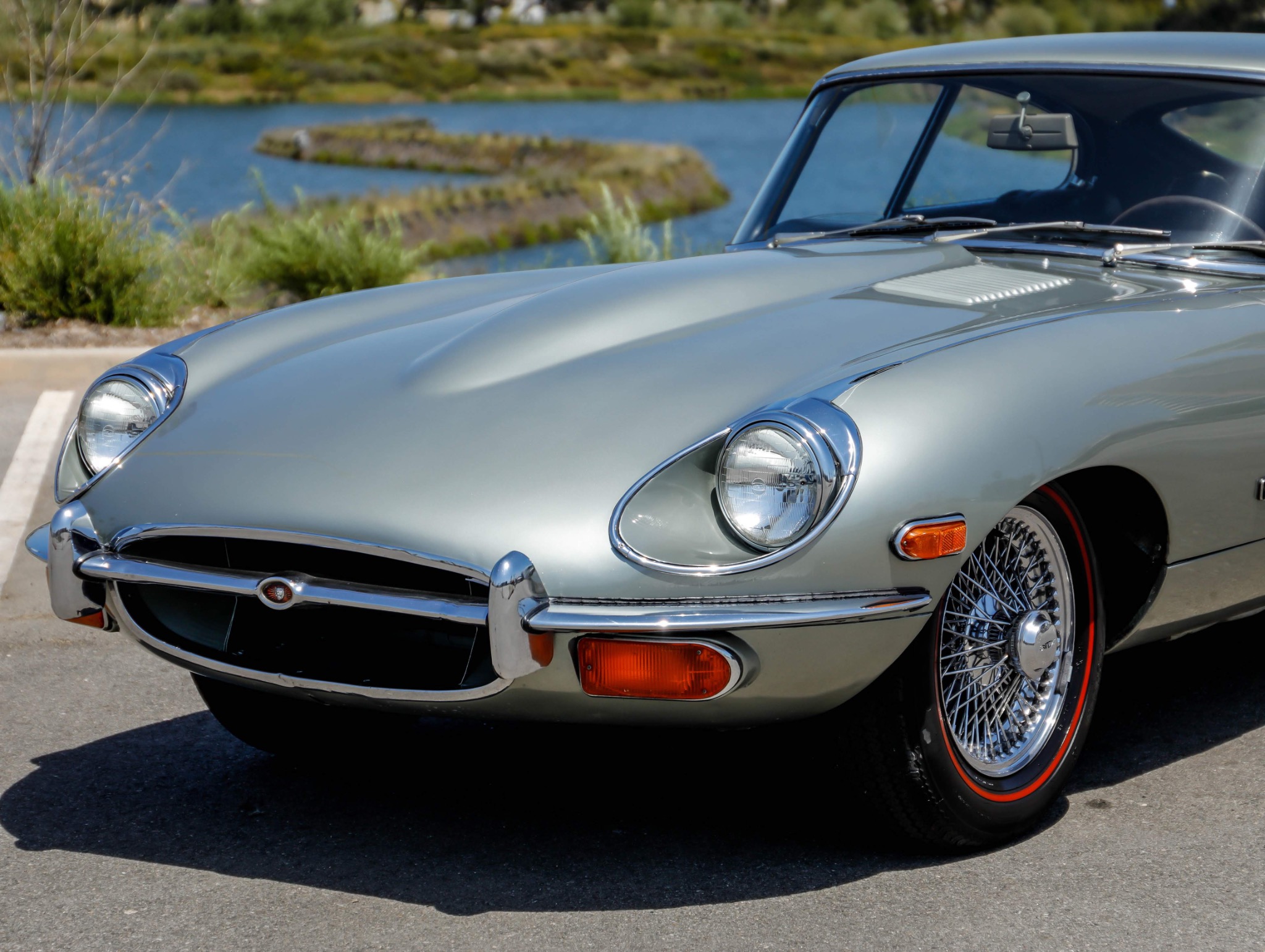
Enzo Ferrari called it "the most beautiful car ever made." The Series 2 E-type with its legendary 4.2-litre inline-six is the quintessential British sports car.
We owned the E-Type during a period when we were driving a lot of California wine country, and there is no better car for it. The long bonnet stretching ahead of you, the deep thrum of the 4.2-litre inline-six at idle, the way the car settles into fast sweeping bends as though it was designed specifically for that road — which, in a sense, it was. Ours was a Series 2 coupe, and we drove it through Paso Robles, up into the Santa Ynez Valley, along the back roads between Santa Barbara and Ojai, and once on a long coastal run that we still talk about. Enzo Ferrari called it the most beautiful car ever made, and we are not going to argue with that. But what surprised us was how involving it was to drive: the XK inline-six pulls with a creamy, linear power delivery that rewards smooth, committed inputs, and there is a sense of occasion to every journey that no modern car can manufacture. It felt like starring in your own period film, and we were sad to see it go.
Pourquoi nous l'avons aimée
The E-type is quite simply one of the most beautiful objects ever created by human hands. But beyond the aesthetics, it was the XK inline-six that captivated us. So smooth, so characterful, with a mechanical richness that modern engines simply cannot replicate.
There's a sense of occasion to driving an E-type that no other car can match. You feel like you're part of automotive history every time you turn the key.
Idéal Pour
Galerie
Itinéraires recommandés
Leave a Comment
Be the first to share your thoughts on the 1971 Jaguar E-type.
Vous connaissez quelqu'un qui apprécierait cette voiture ? Partagez-la avec d'autres passionnés.
Du Journal
Caractéristiques
Puissance
265 HP @ 5400 RPM
Couple
283 lb-ft @ 4000 RPM
Vitesse Maximale
150 mph
0-100 km/h
7.0 seconds
Moteur
4.2L DOHC inline-6 (XK)
Transmission
4-speed manual
Transmission
Rear-wheel drive
Poids
2,910 lbs
Carrosserie
Steel monocoque with aluminum bonnet
Designer
Malcolm Sayer
Production
1968-1971 (Series 2)