
BMW M3 E36 Buying Guide: The Last Analogue M3
The BMW E36 M3 occupies a peculiar place in the M3 canon. For years it was the overlooked generation - too soft to be the E30, not powerful enough to be the E46, too old to be modern. That period of neglect is over. The market has caught up with what drivers always knew: the E36 M3 is the most analogue, most communicative, and arguably the most honest M3 ever built. Cable throttle, hydraulic steering, a naturally aspirated inline-six that rewards commitment - these are qualities that no subsequent M3 has replicated. Prices have risen sharply, and the window for buying a clean example at a sensible price is narrowing fast.
This guide covers everything you need to know to buy one well.
Model History
The E36 M3 was launched at the Paris Motor Show in October 1992, arriving as a coupe with saloon and convertible body styles following two months later. Its development was shaped by a different set of priorities than its predecessor. The E30 M3 had been a homologation special for Group A touring car racing, built to a minimum production number with motorsport as the primary objective. The E36 M3 was a more commercially ambitious project - BMW wanted a car that could be a genuine daily driver while still offering the performance credentials the M badge demanded.
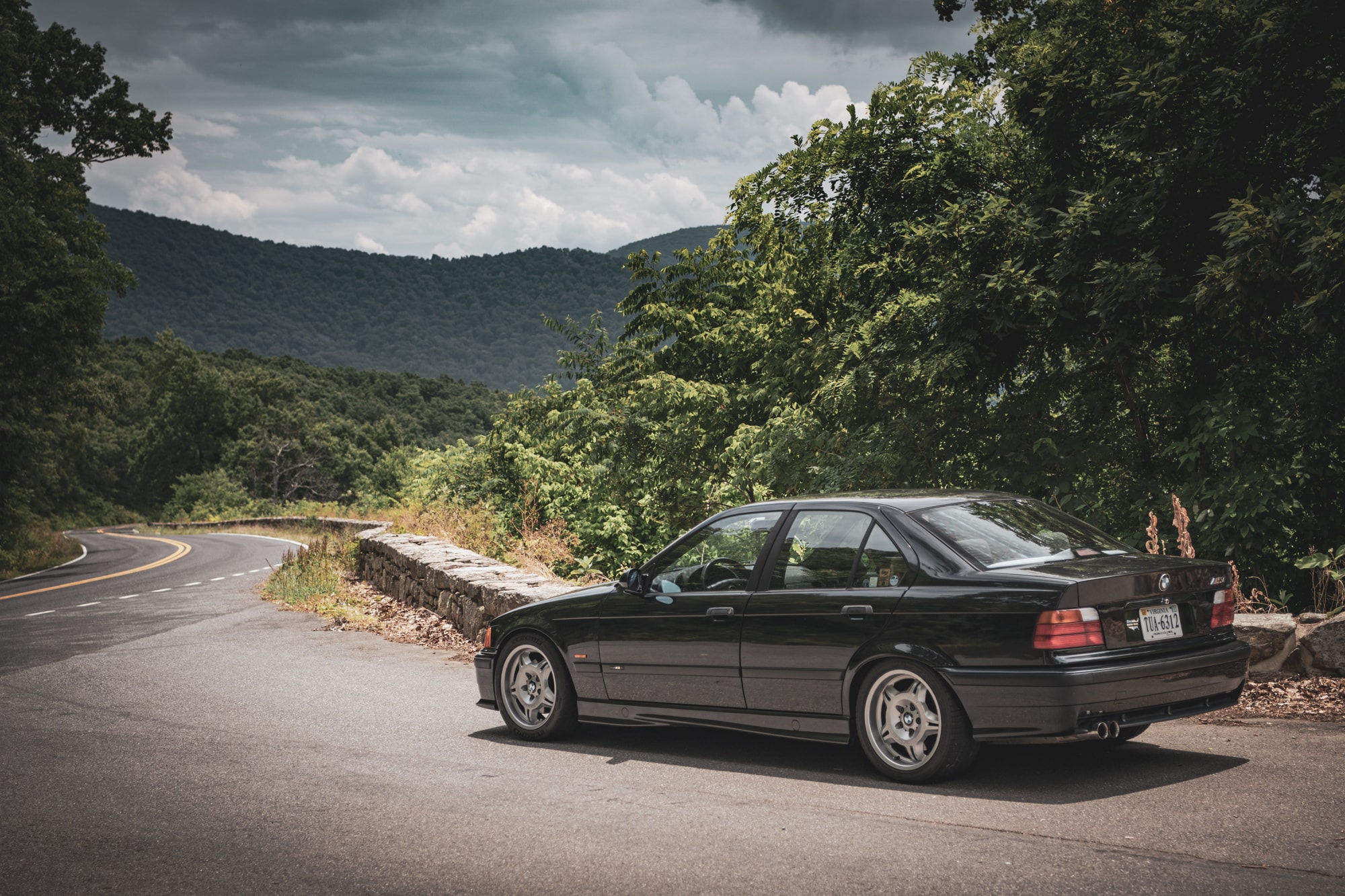
The result was a car that divided opinion at launch. Compared to the E30's aggressive, flared arches and purposeful stance, the E36 M3 looked almost restrained - its visual differences from the standard E36 3-series were subtle. The wider front and rear tracks, the aerodynamic front apron, the M-specific side mirrors and 17-inch wheels were there for those who knew what to look for, but the car did not announce itself. For many enthusiasts, this was a disappointment. In retrospect, it is part of the car's appeal: it is a sleeper in the truest sense.
Mechanically, the E36 M3 was a significant step forward from the E30. The S50B30 engine - a 3.0-litre naturally aspirated inline-six producing 286bhp - was the first BMW production engine to exceed 95bhp per litre. It featured individual throttle bodies for each cylinder, a technology borrowed from motorsport that provides instantaneous throttle response and a distinctive intake sound. VANOS variable camshaft timing was introduced on the M3 for the first time in the 3-series range. The chassis was lowered by 31mm, the track widened, and the braking system substantially upgraded with 315mm front discs.
In autumn 1995, BMW introduced the E36 M3 Evolution - known in the UK as the M3 Evo - with a new 3.2-litre S50B32 engine producing 321bhp. The displacement increase was achieved through a larger bore (86.4mm) and longer stroke (91mm). The S50B32 introduced double VANOS, varying the timing of both intake and exhaust camshafts, and a new six-speed Getrag gearbox replaced the earlier five-speed ZF unit. The S50B32 was the first road-going BMW engine to exceed 100bhp per litre. Production of the E36 M3 continued until 1999, when it was replaced by the E46 M3.
Total worldwide production across all body styles exceeded 70,000 units - a significant increase over the E30 M3's production run and a reflection of the E36's broader commercial appeal.
The Engines: Euro vs. US Specification
Understanding the engine variants is the single most important piece of knowledge for any prospective E36 M3 buyer, because the gap between the European and North American specification cars is substantial.
S50B30 - Euro 3.0-litre (1992–1995)
The S50B30 is a 2,990cc inline-six with a bore of 86.0mm and stroke of 85.8mm. It produces 286bhp (210kW) at 7,000rpm and 236lb-ft (320Nm) at 3,600rpm, with a redline of 7,200rpm. The engine features individual throttle bodies for each cylinder, solid valve lifters, a ported and polished aluminium cylinder head, and single VANOS on the intake camshaft. Compression ratio is 10.8:1. The five-speed ZF gearbox paired with this engine is widely regarded as one of the best manual gearboxes BMW ever fitted to a road car - precise, well-weighted, and robust.
S50B32 - Euro 3.2-litre (1995–1999)
The S50B32 is a 3,201cc inline-six with a bore of 86.4mm and stroke of 91mm. It produces 321bhp (236kW) at 7,400rpm and 258lb-ft (350Nm) at 3,250rpm, with a redline of 7,600rpm. The key advance over the S50B30 is double VANOS - variable timing on both intake and exhaust camshafts - which broadens the torque curve and improves both low-end response and top-end power. A new Siemens MSS50 ECU with three knock sensors manages the engine. The six-speed Getrag gearbox introduced with this engine is good but less celebrated than the five-speed; synchro wear between second and third gear is a known issue on high-mileage examples.
S52B32 - North American 3.2-litre (1996–1999)
The S52B32 is the engine fitted to all North American E36 M3s from 1996 onwards, and it is a fundamentally different unit from the European S50. Despite sharing the 3.2-litre displacement designation, the S52 is derived from the standard M52 road engine rather than the S50 motorsport unit. It lacks individual throttle bodies, uses hydraulic lifters rather than solid ones, has a less aggressive cylinder head, and features only single VANOS. Power output is 240bhp (179kW) at 6,000rpm - 81bhp less than the contemporary European S50B32. The S52 is a good engine, reliable and torquey, but it is not the same car.
For buyers in the US market, the S52 is what you will find in the vast majority of cars. Euro-spec S50 cars do appear in the US market - imported or grey-market examples - and command a significant premium. Verify the engine specification carefully before purchasing.
S50B30US - North American 3.0-litre (1995)
The 1995 US-market M3 used the S50B30US, a 3.0-litre unit rated at 240bhp. Like the S52, it is derived from the standard M50 engine and lacks individual throttle bodies. It is less common than the later S52 cars.
| Engine | Market | Displacement | Power | Torque | Gearbox | VANOS |
|---|---|---|---|---|---|---|
| S50B30 | Euro | 3.0L | 286bhp @ 7,000rpm | 236lb-ft @ 3,600rpm | 5-speed ZF | Single (intake) |
| S50B32 | Euro | 3.2L | 321bhp @ 7,400rpm | 258lb-ft @ 3,250rpm | 6-speed Getrag | Double |
| S50B30US | US (1995) | 3.0L | 240bhp @ 6,000rpm | 225lb-ft @ 4,250rpm | 5-speed | Single |
| S52B32 | US/ROW | 3.2L | 240bhp @ 6,000rpm | 236lb-ft @ 3,800rpm | 5-speed/6-speed | Single |
Variants
Coupe
The coupe is the correct car to buy. It is the lightest and most structurally rigid of the three body styles, and it comes with the iconic Vader bucket seats as standard - a defining feature of the E36 M3 interior and a significant value driver. The coupe is available in both 3.0-litre and 3.2-litre specification in European markets, and in S52 specification in North America.
Saloon (Sedan)
The E36 M3 saloon was a Euro-only body style, never sold in North America. It is mechanically identical to the coupe but uses a four-door body and a conventional steel roof. It weighs slightly more and is marginally less rigid. The saloon does not come with the Vader seats as standard. Production numbers were low - approximately 1,296 LHD and 694 RHD units in 3.2-litre specification - making it relatively rare. Values are typically slightly lower than comparable coupes, which makes it an interesting proposition for buyers who want the M3 experience with four doors.
Convertible
The E36 M3 convertible is the least desirable variant for dynamic driving. The retractable soft top adds weight and reduces chassis rigidity, and the car lacks the structural stiffness of the coupe. It is a pleasant open-top car but not the one to buy if driving engagement is the priority. Convertibles are available in both Euro and US specification.
M3 Lightweight (US, 1995)
The M3 Lightweight (LTW) is the most collectible E36 M3 in the North American market. Only 126 examples were built, all in Alpine White with a Motorsport flag decal. The LTW was stripped of non-essential items - radio, air conditioning, sunroof, and sound deadening were all deleted - and fitted with aluminium doors, a carbon-fibre front splitter, and a rear wing. Despite using the standard S50B30US engine, the shorter final drive ratio and reduced weight (approximately 100kg less than a standard US coupe) made it a significantly more focused car. Values for exceptional examples now exceed $150,000 and continue to rise.
M3 GT (Euro, 1995)
The M3 GT was a homologation special produced for the FIA GT series. Approximately 356 units were built, all in British Racing Green. The GT featured a more aggressive camshaft, revised intake manifold, and higher compression ratio, boosting power to 295bhp. Other distinguishing features included adjustable front and rear spoilers, unique 17-inch alloy wheels, aluminium doors, and a stripped-out interior with Vader seats and green Nappa leather. The GT is a genuine collector's car. Prices for sorted examples range from $51,000 to $102,000 with the best examples exceeding six figures.
M3 Evolution (Euro, 3.2-litre)
In the UK, BMW GB used the "M3 Evolution" designation to differentiate the 3.2-litre S50B32 cars from the earlier 3.0-litre models. Mechanically and cosmetically, the Evolution is identical to other European-spec 3.2-litre M3s - it is a marketing designation rather than a distinct variant. The 3.2-litre cars are the most desirable standard-production E36 M3s and command a premium over the 3.0-litre cars in the UK market.
Known Issues
Rear Subframe Cracking
This is the most structurally significant issue with the E36 chassis and affects all E36 models, including the M3. The rear subframe is attached to the chassis via spot-welded mounting points. Over time - particularly on cars that have been driven hard, used on track, or fitted with stiffer aftermarket bushings - these spot welds fatigue and crack. The failure typically begins at the mounting points and propagates into the surrounding chassis metalwork.
Symptoms include a clunking or knocking noise from the rear of the car under acceleration, braking, or cornering, and a progressive deterioration in rear-end handling precision. In severe cases, the subframe can separate partially from the chassis, which is a safety-critical failure.
Inspection at purchase requires getting the car on a ramp and examining the rear subframe mounting points carefully with a torch. Look for cracks in the surrounding sheet metal, evidence of previous repairs (welding, filler, paint overspray), and any movement in the subframe relative to the chassis. A car with cracked subframe mounts is not necessarily a deal-breaker - the repair is well-understood and can be done properly - but it must be reflected in the price. Reinforcement kits from specialists such as Garagistic and Turner Motorsport are available and widely recommended as a preventative measure. The cost of a proper subframe repair and reinforcement by a specialist is typically $650–$2,500 depending on the extent of the damage.
BMW reportedly introduced factory reinforcements to the rear floor and front strut towers on 1996 and later E36 M3s, making earlier cars more susceptible. However, any E36 M3 driven hard should be inspected carefully regardless of model year.
Cooling System
The E36 M3's cooling system is its most maintenance-intensive area and the source of the most catastrophic failures. The system uses plastic components throughout - water pump impeller, thermostat housing, radiator end tanks, expansion tank - and all of these degrade with age and heat cycling.
The water pump is the most critical component. Early pumps used a plastic impeller that can disintegrate without warning, causing sudden and complete loss of coolant circulation. The consequence is rapid overheating, which on the S50/S52 inline-six typically means head gasket failure or a warped cylinder head - repairs that can cost $2,500–$6,400 or more. The fix is straightforward: replace the plastic-impeller pump with a metal-impeller unit from a reputable supplier (URO, Stewart). This should be done proactively on any car where the pump's history is unknown.
The radiator's plastic end tanks crack with age, particularly at hose connections and along the seam with the aluminium core. The expansion tank cracks along its seams. The coolant hoses harden and become brittle. A comprehensive cooling system overhaul - water pump, thermostat and housing, radiator, expansion tank, all hoses - costs approximately $500–$1,000 in parts and should be considered essential maintenance on any car over 80,000 miles or where the service history is incomplete.
At inspection, check for coolant residue (pink or green staining) around the radiator, hoses, water pump, and expansion tank. Squeeze the hoses - they should be firm but pliable, not hard and brittle. Check the coolant level and colour. Any milky or oily contamination in the coolant is a serious red flag indicating head gasket failure. During the test drive, watch the temperature gauge: it should stabilise at the halfway mark and remain there. Any fluctuation or reading above halfway is a warning sign.
VANOS Failure
The VANOS variable camshaft timing system is a known weak point on both the S50B30 (single VANOS) and S50B32 (double VANOS). The internal seals within the VANOS solenoids degrade over time - typically around 50,000 miles - leading to oil pressure loss within the unit and incorrect camshaft timing.
Symptoms of VANOS failure include a rough or lumpy idle, hesitation and stumbling under load (particularly below 4,000rpm), a noticeable loss of low-end torque, and a rattling or growling noise from the engine on cold starts. The double VANOS unit on the 3.2-litre cars is more complex and more expensive to rebuild than the single unit on the 3.0-litre cars.
A VANOS seal replacement is a relatively affordable repair - seal kits from Beisan Systems are widely used and cost approximately $100–$200 - and can be a DIY job for a competent home mechanic. A full VANOS unit rebuild or replacement by a specialist costs $400–$750 for the single unit and up to $1,900–$2,500 for the double unit. Specialists such as Mr Vanos in the UK focus exclusively on VANOS rebuilds and are widely recommended.
Rust
Rust is the E36 M3's most significant long-term threat and the factor that most clearly separates a good buy from a money pit. The car's age - the youngest examples are now over 25 years old - means that rust is present to some degree on the majority of UK and northern European examples.
The most critical areas to inspect are the rear wheel arches (rust typically starts from the inside and bubbles outward), the sills (particularly under the M-technic side skirts, which trap moisture), the jacking points (often damaged by improper jack placement, allowing moisture ingress), the boot floor (around the battery tray and spare wheel well), and the front subframe mounting points. Sunroof drains, if blocked, allow water to collect in the sills and floor pans, causing extensive rust from the inside.
Inspection requires a ramp, a torch, and ideally the removal of the side skirts. Check under the carpets for dampness. Feel along the inner lip of the rear arches for roughness or bubbling under the paint. Probe the sills and jacking points. Any structural rust in the sills, subframe mounting points, or floor pans is a serious issue - repair costs can run to several thousand pounds and the quality of previous repairs is often poor.
Cars from drier climates - California, southern Europe, South Africa - are substantially less likely to have significant rust issues. UK and northern European cars require the most careful inspection. A rust-free chassis is worth paying a significant premium for.
Rear Trailing Arm Bushings (RTABs)
The rear trailing arm bushings are a wear item that has a significant effect on the car's handling. Worn RTABs cause instability from the rear under acceleration and braking, a vague or wandering rear end, and can contribute to the subframe cracking issue by allowing excessive movement. Replacement is straightforward and affordable - budget $250–$500 for parts and labour. Inspect for play in the trailing arms at purchase.
Electrical Gremlins
Window regulators are a common failure point - the plastic clips that hold the window glass in the regulator channel break, causing the window to drop into the door. Central locking actuators fail with age. The instrument cluster develops dead pixels over time, making the odometer difficult to read. None of these are serious mechanical issues, but they add up. Budget $250–$650 for electrical tidying on a typical example.
Gearbox Synchros
The six-speed Getrag gearbox fitted to 3.2-litre Evo cars can develop synchro wear between second and third gear on high-mileage examples. The symptom is a crunching or resistance when changing from second to third, particularly when cold. The five-speed ZF gearbox on the 3.0-litre cars is more robust and rarely causes problems. Check the gearchange carefully during the test drive.
Pre-Purchase Inspection Checklist
The following checklist covers the key items to verify before committing to any E36 M3 purchase.
Under the car (on a ramp):
- Rear subframe mounting points - inspect for cracks, previous repairs, movement
- Sills and jacking points - probe for rust, check for filler or paint overspray
- Rear wheel arch inner lips - check for rust bubbling from inside
- Boot floor - check around battery tray and spare wheel well
- Coolant system - check for leaks around radiator, hoses, water pump
Engine bay:
- Coolant level and colour - should be clean, no milky contamination
- Coolant hoses - squeeze for pliability, check for cracks or staining
- Radiator end tanks - check for cracks, especially at hose connections
- Expansion tank - check for cracks, discolouration
- Oil level and condition - check dipstick for milky or frothy oil
- VANOS unit - listen for rattle on cold start
Interior:
- Instrument cluster - check for dead pixels
- Window operation - check all four windows operate smoothly
- Central locking - test all doors
- Carpets - lift and check for dampness (indicates blocked sunroof drains or leaks)
- Vader seats - check for wear, tears, or damage (costly to repair or replace)
Test drive:
- Temperature gauge - must stabilise at halfway and remain stable
- VANOS - listen for cold-start rattle, check for hesitation below 4,000rpm
- Gearchange - check for synchro wear between 2nd and 3rd (3.2-litre cars)
- Rear end - listen for clunking under acceleration/braking (subframe, RTABs, diff)
- Steering - should be direct and communicative, no play or vibration
Running Costs
| Item | Cost (UK) | Interval |
|---|---|---|
| Inspection I service | $300–$400 | Annual |
| Inspection II service (incl. valve clearances) | $450–$500+ | Every 2 years |
| Cooling system overhaul (parts) | $500–$1,000 | Once (if not done) |
| VANOS seal rebuild | $100–$200 (DIY) / $400–$750 (specialist) | 50,000 miles |
| Rear tyres (per corner, premium) | $200–$250 | ~12,000 miles |
| Rear trailing arm bushings | $250–$500 | As required |
| Subframe reinforcement | $650–$2,500 | As required |
| Clutch replacement | $750–$1,100 | As required |
| Fuel consumption | 20–30mpg | - |
Price Guide (2025, UK)
| Variant | Condition | Price Range |
|---|---|---|
| Standard coupe (S50B30 or S52, high mileage) | Good, usable | $10,000–$19,000 |
| Standard coupe (S50B30 or S52, well maintained) | Very good | $19,000–$28,000 |
| 3.2 Evolution coupe (S50B32, Euro) | Good, usable | $19,000–$32,000 |
| 3.2 Evolution coupe (S50B32, Euro, low mileage) | Excellent, documented | $32,000–$51,000 |
| Saloon (Euro, S50B32) | Good | $15,000–$28,000 |
| Convertible | Good | $12,500–$23,000 |
| M3 GT | Good–Excellent | $51,000–$102,000+ |
| M3 Lightweight (US) | Good–Excellent | $80,000–$150,000+ |
E36 vs. E46 M3: Which to Buy Today?
The E36 and E46 M3 are frequently compared, and the choice between them is genuinely difficult. The E46 is faster, more powerful (333bhp vs 321bhp in European specification), and more refined. Its S54 engine is arguably the finest naturally aspirated inline-six BMW ever built. But the E46 is also more complex, more expensive to maintain, and carries the IMS bearing risk that the E36 does not.
The E36 offers something the E46 cannot: a completely analogue driving experience. The cable throttle provides a directness and immediacy that the E46's drive-by-wire system cannot replicate. The hydraulic steering delivers more feedback. The car is lighter, simpler, and more forgiving of neglect. It is also - at current prices - typically cheaper to buy than a comparable E46, though that gap is narrowing.
For a first-time M3 buyer, the E36 is the more accessible car. For someone who wants the definitive naturally aspirated M3 experience and is prepared to manage the IMS bearing risk, the E46 is the better driver's car. The E36 is the car for those who value connection and simplicity above outright performance.
Verdict
The E36 M3 is the most honest M3 ever built - a car that rewards the driver rather than doing the work for them. The 3.2-litre Evolution coupe with the S50B32 engine is the variant to target: it offers the full M3 experience with the best engine, the best gearbox, and the most focused chassis. A well-maintained, rust-free example with documented cooling system work and VANOS service history is a car that will appreciate in value and provide years of driving pleasure.
The key risks are rust, cooling system neglect, and subframe cracking - all of which are manageable if identified at purchase and reflected in the price. The key to buying well is prioritising condition and history over mileage, insisting on a ramp inspection, and budgeting for the maintenance items that every example of this age will require.
Buy the best you can afford. The E36 M3 market has been rising steadily for five years and shows no sign of reversing.